
the storm came indoors
-Brandie, Assistant Director
ceiling tiles drip onto
puddle-covered floors
Saturday, November 12th, 2022

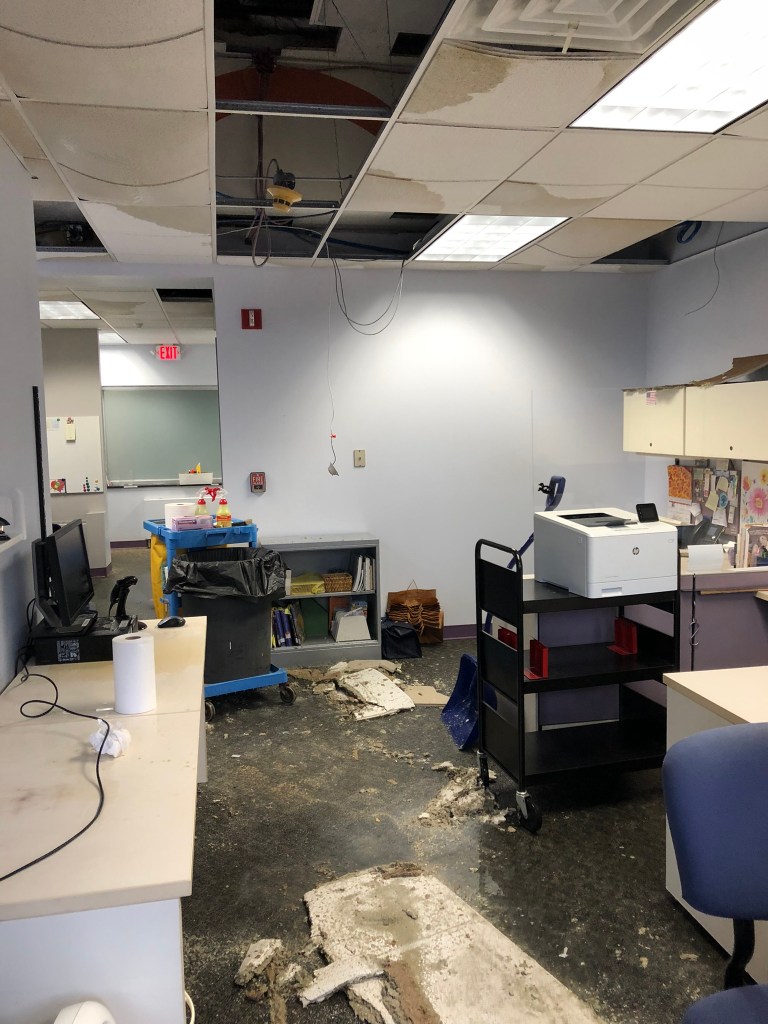
Hurricane Nicole passed over Middletown during the night of Friday, November 11th. I remember looking forward to a quiet day of reference work as I drove up to the building. I am the department head for circulation and cataloging, but I routinely work all three desks most of the day on my Saturdays. That day, as I walked inside, the first inkling that something had gone wrong was a yellow “Wet Floor” sign outside of the circulation office. Jon, our Saturday custodian, warned me that the roof had leaked in there. I didn’t understand how much until I went in myself, still expecting to drop my bag off at my desk.
I couldn’t even get to my desk. In between where I stood and where my desk sat lay hundreds of gallons of water. Ceiling tiles in the Circulation Office sagged with water weight. Many had fallen to the floor in the torrent. Files had been reduced to soggy paper fiber. In the book delivery room, novels floated in watery graves. You could splash in puddles on the carpet.
The Bank had flooded.
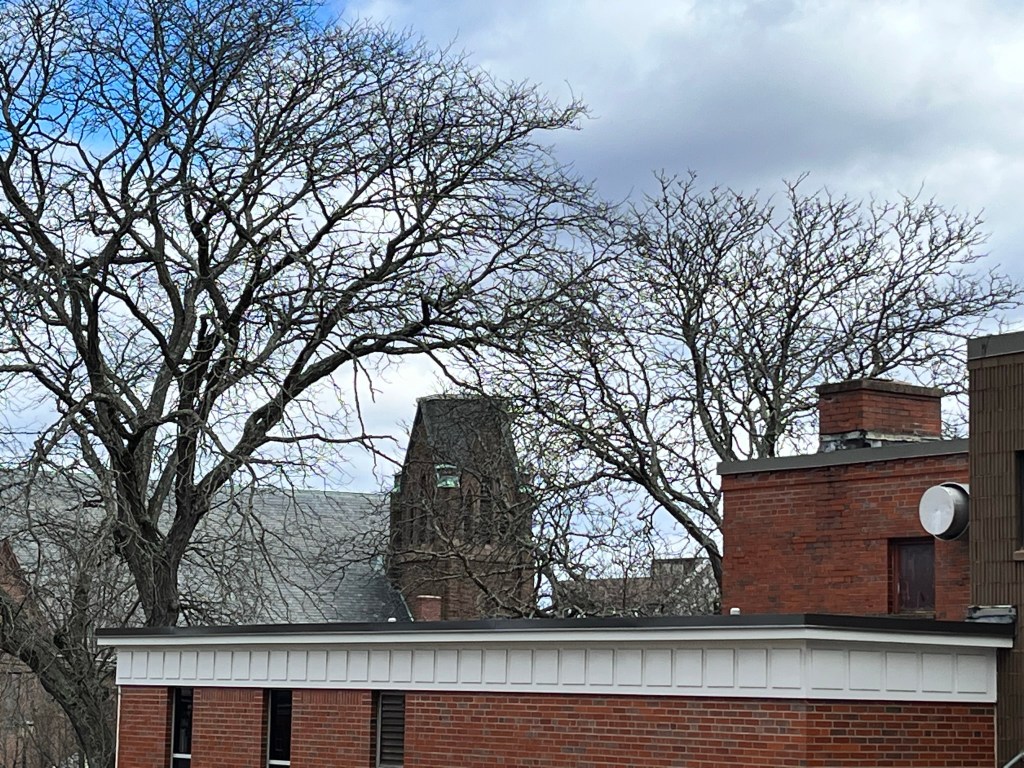
Russell Library started out in the 19th century as the Church of the Holy Trinity, built in 1834. Francis Russell, wife of the local merchant Samuel Russell, purchased the building when the congregation moved to Main Street in the 1870s. The library opened to the public in 1876, in memory of Samuel Russell. In 1930, a children’s library was added as the room we now know as the Hubbard Room. In 1972, the library purchased a freestanding bank on the lot next door. It became the new children’s library. Ten years later, the two separate structures were joined together by a new lobby, the Information Department, and the children’s book areas. We call the joined buildings “The Frankenbuilding” because they are strangely jointed together. What had been the bank became the Activity Room, the Circulation Office, and the Processing Office in the basement. We kept the bank vault for storage.
In November of 2022, it only rained in The Bank. On Friday night, as the library lay sleeping, Nicole blew water and rain over the Frankenbuilding’s four roofs. Most of our roofs are sensibly peaked against snow and rain. The Bank’s roof is flat. Leaves clogged its single drain, which backed up. Water poured down into the Circulation Office and Activity Room. It saturated the drop ceilings. It filled book delivery bins. It covered the floor of our book-drop. It dripped into the basement, soaking hundreds of feet of network wiring and more staff desks.
I doubt I will ever forget the sight of two ceiling tiles hanging directly over my colleagues’ desks, so stretched with water that they bent like U’s a foot toward the ground. We had to dash in and grab what stuff we could before the tiles collapsed: picture frames, mementos, plants, you name it. Fate favored us at least in that instance, as none of us got dumped on.
Our director, Ramona, arrived early on. She and Jon waded in where others feared to tiptoe. Ramona tackled the soaked piles of books in the fireproof – but ironically not waterproof – book-drop. Jon heroically lugged heavy computers and printers through ankle-deep puddles. Water filled even the air. Though the temperature in the room was the normal 70-something degrees, the humidity was as high as a summer day in New Orleans. The sound of water dripping from a dozen places filled the rooms. The usual hum of machines had silenced. It sounded like being in a wet cave.

Emergency staff left their families on their days off to assist with rescue operations. Regularly scheduled Saturday staff saved what items we could, and kept the library operating until the afternoon, when teams of specialists arrived to dry the entire area out. They eventually ran so many extension cords through the Lobby and the children’s department that those areas were no longer safe for pedestrians and we had to close. We pulled books from puddles. We poked bloated ceiling tiles to discharge their water. The president of our Board of Trustees brought us coffee and donuts. City inspectors and a fire chief wandered around, checking for safety issues. ServPro arrived with hundreds of fans and sophisticated digital water meters. They reminded me of Star Trek redshirts, exploring every nook and cranny with their tricorders that incessantly beeped and flashed red lights.
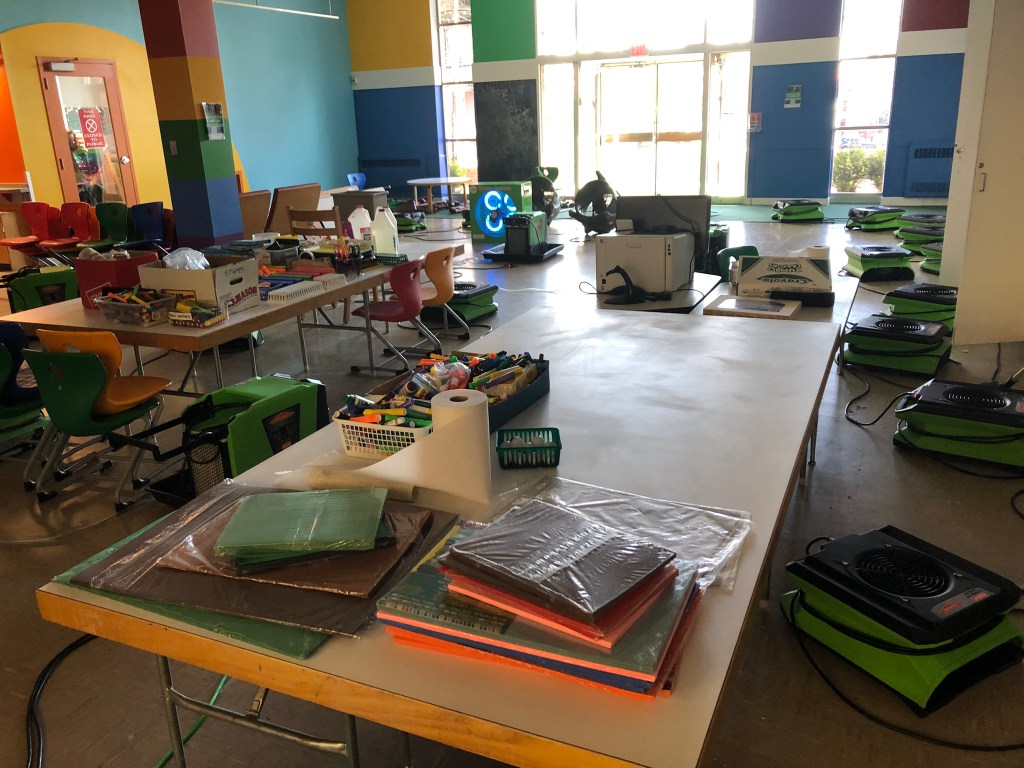
The flooding of the bank caused an approximate $60,000 in damages to the library. Several hundred books were destroyed. The library closed to the public for four and a half days to dry out. Facilities staff and administrators worked tirelessly to clean up the mess, including coming in on both Saturday and Sunday. Some staff, including administrators, worked for a week straight with no days off. The two affected staff areas are currently being completely gutted and refurbished. The Activity Room finally reopened on March 9th, almost four months later.
Since the November 12th flood, the library has already flooded again. It was the weekend of that deep cold spell: Saturday, February 4th. I worked that Saturday shift, too, and the heat in the Lobby failed because of the extreme cold. Staff and patrons had to wear coats and hats in the Lobby and the children’s department. Technicians were immediately brought in to work on the problem, but they could only do so much with our ancient and over-taxed HVAC system. At 2am that night, one of our security alarms went off. When Facilities staff rushed to the building, they found that a pipe under the Lobby had burst due to the cold. It flooded several basement rooms, including an office area and our staff kitchen.
Operating an urban library out of “The Frankenbuilding” never ceases to bring surprises and challenges. The improvements made in the 1980s were only designed to last until the year 2000. Now, 23 years later, the costs of keeping the dying building alive keep adding up. That’s why a Feasibility Study was recently approved by Middletown’s Common Council to investigate building a new central library. They are working now to determine if a better location (or locations) can be found. Stay tuned as the Russell Library saga continues…

 The Library Vault
Leave a comment