When my husband and I had our first child, we thought we had done everything we possibly could to prepare. We read a ton of medical books on pregnancy and infant care. We attended every relevant class offered at the local university’s hospital. Because my husband had a generous course reduction from his college, he was able to be a very hands-on father from day one and took the baby for half of each night. We thought we could muddle our way through any parenting challenges.

Of course, our new baby completely kicked our butts. From day one, she barely slept and ate. I stopped sleeping almost entirely for the first month between nursing her 18 hours a day, postpartum hormones, and the stress of our lives being 100% changed. When our loving friends and family gave us a baby swing and a Rock-n-Play (now recalled, unfortunately) she did finally start sleeping for three hour stretches for a few weeks. But then we moved across the country, and everything reset.
We all stopped sleeping again until our baby was about six months old, despite constant application of Dr. Richard Ferber’s progressive wait sleep training technique from the book Solve Your Child’s Sleep Problems. It helped a little, but not much. Finally, our pediatrician intervened and had us give our daughter a bottle of formula at bedtime. She immediately stopped her 2am-4am nightly waking spells. We finally started to get our lives back.
Despite the increased sleep, bedtimes were still a nightmare. Our daughter took 2-3 hours to fall asleep at bedtime every night, despite our attempts at routine. There was constant screaming. She had at least one long nighttime waking spell every week. Her naps were practically non-existent. Still, it was a massive improvement from the first six months, and we limped along until after Christmas when she was almost three. She had been getting very frequent ear infections. Her ENT told us that her beloved pacifiers were the culprit. The binky had to go. The ear infections did indeed significantly reduce as a result, but her sleep instantly regressed to that of a newborn again. Soon, we were exhausted and in despair.
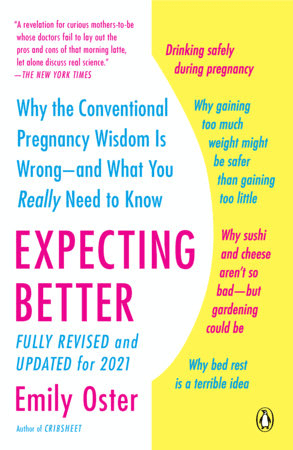
Around this time, as we were considering whether we could survive a second child, I came across the book Expecting Better by Dr. Emily Oster of Brown University. It’s a book about pregnancy that studies where the current medical recommendations on pregnancy come from, and whether or not they’re actually based on reliable data.
Dr. Oster is an economist who specializes in health data, not a medical doctor. Much of her book is dedicated to explaining how medical studies work. In our modern world full of case studies and data, the layman often assumes that they are all equally valid – though often confusing and conflicting. They are not. For example, Dr. Oster points out that many medical recommendations are based on studies with only a few dozen people in them, which is not enough for an objective conclusion. Other studies have deeply flawed methods or assumptions, or fail to prove correlation vs. causation. Dr. Oster goes into the science of data to a deep – yet approachable – degree. She radically changed how I evaluable the tsunami of data that hits us every day from every direction. Instead of giving medical advice, she presents the evidence and lets the parents decide what’s best for their families.

Dr. Oster then followed up Expecting Better with Cribsheet, which focuses on data about infant and toddler care. She looks at the data about controversial parenting topics like sleep training, breastfeeding vs. bottle (don’t get me started on that one! I’ll just say it’s a false dichotomy and leave it at that), and vaccinations. Her third book, The Family Firm: a Data-Driven Guide to Better Decision-making in the Early School Years, came out just last year. It looks at the data available for decisions like enrolling your child in school when they’re four-and-a-half versus five-and-a-half (the latter being called “red-shirting”). With Connecticut’s new law going into effect in 2024 that four-and-a-half year-olds need special permission to go into kindergarten, its particularly pertinent in Middletown. Taken together, Dr. Oster’s books and blog bring a new data-driven philosophy option to modern parents that my husband and I just love.
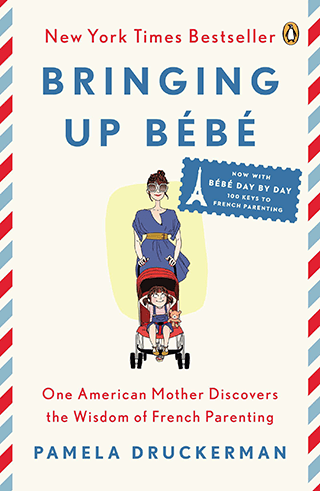
My husband and I began to subscribe to Dr. Oster’s parenting newsletter/blog ParentData. It contains cutting edge studies (often critiques of them) and reviews of books that she has found helpful. In one of her newsletters, she recommended the book Bringing Up Bébé: One American Mother Discovers the Wisdom of French Parenting by Pamela Druckerman. The book compares American vs. French parenting styles, and is a fascinating read if you love culture and/or Europe. It taught me that many things I took for granted about baby behavior and parenting were actually just American culture, not necessarily “nature”. For example, I had assumed that virtually all babies sleep poorly for the first year, except a very fortunate few who happen to sleep well early on or are fed formula exclusively. According to Druckerman, French babies routinely “do their nights” (or sleep through the night) from the age of 2-3 months. What?!?!?
Bringing Up Bébé gave me my first exposure to key concepts like “The Pause”. According to the book and to French-born pediatrician Dr. Michel Cohen, whom Druckerman interviews and references throughout, babies are a lot smarter than we Americans often give them credit. They don’t need us to rush to their sides the second they make a peep, as I was doing throughout every night when my daughter was a newborn. Instead, if you use “The Pause”, they will actually learn to put themselves back to sleep. This eventually leads to babies who are self-sufficient sleepers. “The Pause” means that you let them fuss for 5-10 minutes when they make noise, especially at night and during naps. If they don’t go back to sleep after 10 minutes, you go in and see what they need. It’s very simple.

Every person, including babies, wakes up between sleep cycles. We have multiple sleep cycles throughout the night. Both adults and children who sleep well have learned to fall asleep quickly and fall back asleep between cycles without help. I had inadvertently taught our daughter to need help falling back asleep whenever she woke up from a sleep cycle … all night long. This also affected bedtimes and naps, when she did not know how to fall asleep by herself to begin with. Applying “The Pause” (combined with ‘Drowsy But Awake‘) from early on allows a baby to learn to fall asleep on their own, and to sleep throughout the night.
We used this technique starting when our son was a newborn, and he has been an amazing sleeper ever since. We never had to “sleep train” him because he learned good sleeping skills right away. Both of our kids now sleep from 8pm to 7am every night, with a short bedtime routine (about half an hour). Our son, now a toddler, takes an afternoon nap every day from 1-4pm (1-3pm at daycare) like clockwork. He is the easiest toddler I could have imagined, and I fully credit the techniques we learned from Dr. Cohen.

Dr. Cohen has very kindly digitized his book chapter on sleep. That’s right, book chapter. Instead of reading entire books about sleep, you can read this chapter in 10-20 minutes. The chapter contains guides for sleep based on the baby’s (or child’s) age. He does recommend a “progressive wait” method similar to Ferber’s for ages 8-12 months, but that’s where the similarities end. Some people call Cohen’s method “the extinction method” and lambast it as a cruel, neglectful method because you let the child figure out how to sleep on their own. (Reliable studies all show otherwise, also see Cribsheet chapter 11.) After four years of a tired, cranky, unhappy child and two exhausted and cranky parents, I’ve come to the conclusion that waiting so long to fix the problem was the cruel part. Dr. Cohen’s plan worked in one night and only involved fifteen minutes of my daughter’s crying. After that, she learned to fall asleep and stay asleep by herself. She already had the skills, we just finally insisted that she use them. I think of Dr. Ferber’s progressive waiting technique as pulling a band-aid off very slowly, and Dr. Cohen’s as pulling it off quickly. To me, that’s torture vs. mercy.
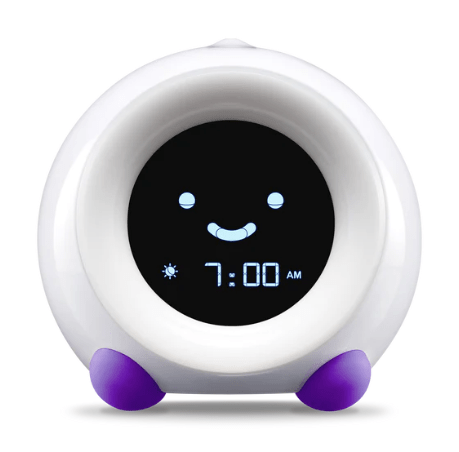
I definitely recommend a video monitor for the process, so that you can reassure yourself that your child is physically OK. In our case, we told our almost-four-year-old about the new rules. It was very simple: do not leave your bedroom after bedtime except to use the bathroom, if you’re sick, or if you’re terrified. She was fine until her usual 2am wake-up time. Then she left her room and woke us up. We put her back in her room and did not let her leave her room again. I watched her on the video monitor. She cried for fifteen minutes and then stopped, put herself back to bed, pulled her covers up to her chin (which was amazing because she always claimed that she couldn’t do that), and promptly went back to sleep. She stayed asleep until her Mella clock turned green at 7:30am. Every night after that, she went to sleep right away and slept through the night. That was four years ago.
My family’s journey from exhausted to well-rested has demonstrated to me how books can change lives. Perhaps one book by itself won’t solve your problems, but researching and reading can. While the solutions that worked for my family may not work for all families, I firmly believe that all families can benefit from searching for their own solutions through books and other expert information sources. That’s one reason why public libraries are so important, so we can test books out without having to buy them. While I ultimately have bought copies of all the books I recommend in this post, I started out by getting copies of each one from my library for free.
 The Library Vault
Leave a comment