Winter is the season of storytelling. In some cultures, November 1st marked the start of the New Year: the end of the harvest and the beginning of winter. True to form, this year in Middletown the first frost came between the dusk of November 1st and the dawn of November 2nd. Now the remaining crops shrivel on the vine, and anything you wish not to freeze outside must be brought indoors.

With Saturday, November 5th comes the dark days until spring. The sun set at 4:40PM on Sunday, November 6th. Now the dusk will begin one minute earlier every day until the winter solstice on December 21st. Then we gain one minute of daylight a day until the summer solstice on June 21st. The cycle of waning and waxing light continues through millennium, shaping our daily lives.
With so much darkness in the late fall and winter, activities move indoors. Traditionally, storytelling served as a major form of winter entertainment and education. “Storytelling” makes me think of folk tales told around a hearth by an elder a hundred years ago in the Appalachians or 300 years ago in colonial America. I think of the novel Watership Down, in which rabbits pass stories and mythology about their predecessors down from generation to generation while huddled together in warm, dark warrens. I think about scary stories told by children to each other around campfires or at slumber parties after the adults have gone to bed. The Victorians told ghost stories to each other at Christmas around their fireplaces, which is one reason why Charles Dickens filled A Christmas Carol with ghosts.
If you find an old edition of a book originally published more than 100 years ago, you may still find that each right-hand page has the first word of the next page printed under the text at the very end. These books were printed in a time before television or even radio, when reading aloud to a group of friends or family was a common past time at evening’s end. They are elusive now as the old books disintegrate and modern editions printed in China slowly fill our shelves.
In Pride and Prejudice by Jane Austen, the Bennet family’s cousin the Reverend Collins visits for several weeks and insists on reading sermons by his beloved Fordyce to the reluctant and impatient young ladies. At the time, reading aloud was a staple of social life – an experience shared by household members, friends, and visitors. The publishers from that period wanted to enable the orator to present a seamless performance. The reader could turn the page while reading its first word at the same time. Reading aloud was a skill to be honed in many households.
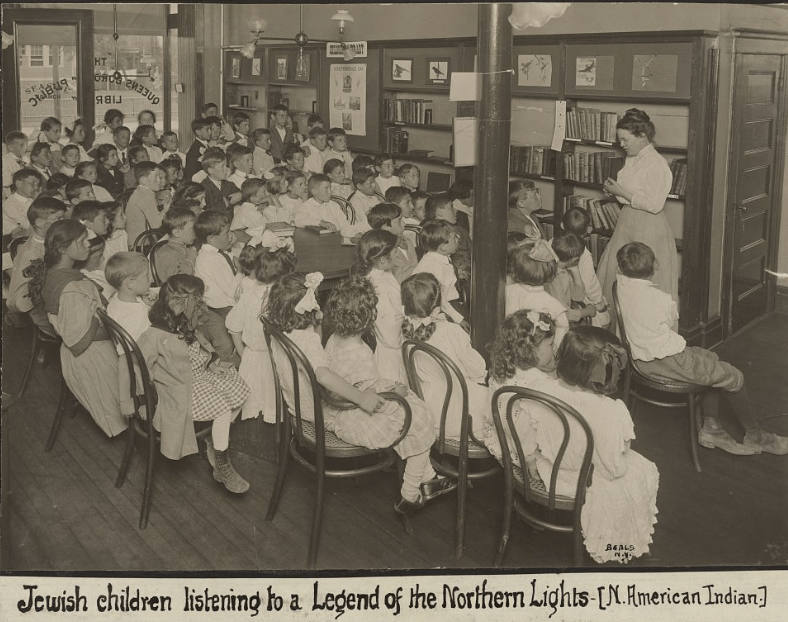
Compare that to today in America, when reading aloud happens mostly in institutions or for private devotions. Children practice reading aloud in school to enhance their comfort with the written word. Librarians read aloud in public libraries. Families with religious traditions may read aloud from a religious text for a holiday in the privacy of home. Leaders of religious institutions read aloud to their followers in their houses of worship.
In the children’s department at Russell Library, librarians like myself mostly read picture books to groups of children in order to encourage reading and literacy. We sometimes use props like puppets or picture boards to reinforce the message or ideas. We did tell stories to children about our library for the Secrets, Jr. tours in October during tours around the buildings. We don’t usually create our own stories. I’m not sure I would call myself “a storyteller” or a performer.
True storytellers may never reference a book for their performances. Their material may come from oral tradition or local history knowledge. They may use dance or song to tell stories. Many songs, like ballads, are at their heart stories. Some of our first recorded poetry may have been read aloud in order to pass down knowledge from generation to generation.

This November and December, Russell Library will be partnering with the Connecticut Storytelling Center. This non-profit organization nourishes the art of storytelling by sending professional storytellers out into the community. Patrons of all ages will have the chance to listen to and interact with two real life storytellers. The events are called “Tellebrations“. Join us on Saturday, November 11th and December 4th at 10:30am in the Activity Room, and help us keep the art of storytelling alive. All ages welcome.

 The Library Vault
Leave a comment