
Down Below by Leonora Carrington
Rain putters against the window. Grey skies encompass the building of old that fosters knowledge within its walls. It cultivates a home for life-long learning. Libraries are a creative living organism – an analogy learned in grad school that holds truth. Libraries are ever-evolving to fill the void and meet the needs of the communities they serve. Libraries provide more than just books. Unique to libraries are the programs held in our distinctive institutions. A program was held at Russell, it inspired the wine and book pairing. It opened up my sense of knowledge to something greater and allowed me to see beyond.
Observing from the clouded window of dread, I impersonated one of the children from Cat in the Hat. Stuck inside on a rainy dreary afternoon, dreaming of warmer sunlit days. My Cat in the Hat miraculously appeared, bringing sunshine back to my existence. The sunshine was the wondrous imaginations of surrealist female artists. The program was called “Frida Kahlo and Female Surrealists.” I love Frida, but she did not draw my inspiration. It was the surrealist Leonora Carrington who stole the show.
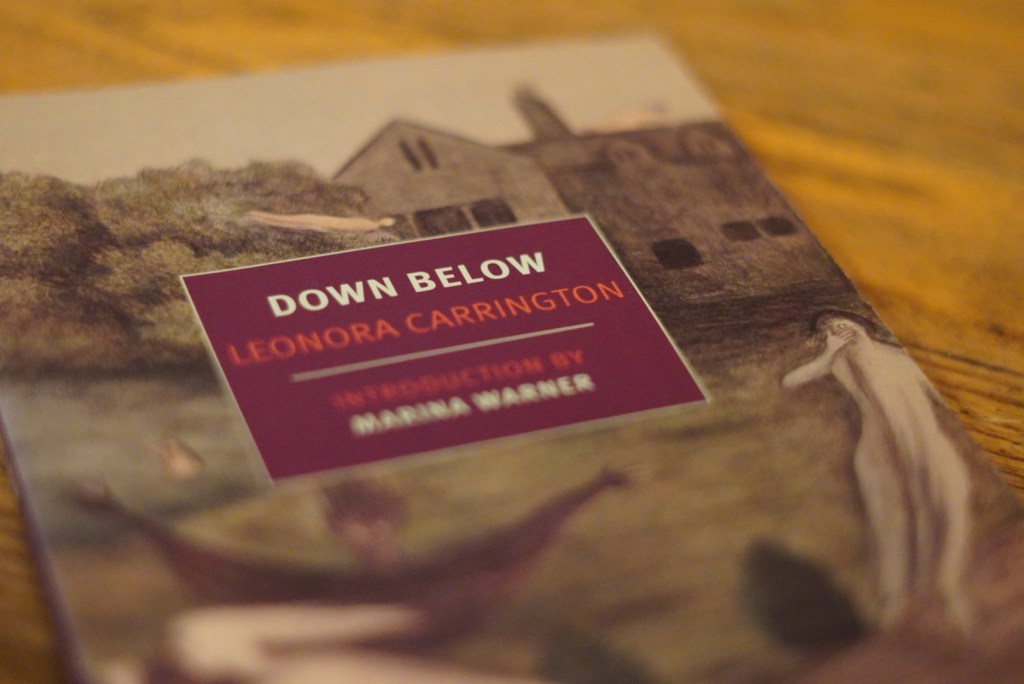
More than a surrealist painter, to me Leonora Carrington defines a true artist. Carrington wrote stories. The short story Down Below portrayed journey of her own personal madness. Carrington was confined in a mental institution at a young age, suffering from psychosis. The story’s language is simple. The reader joins Carrington on her agonizing journey. The sentence structure is matter of fact, engendering eeriness with every word. The short novella can be read in one sitting, with an everlasting effect. The question is, how did she get into an institution? What happened? What wine could possibly go with a desolate novella? I think the best way to start is to tell you, dear reader, a little bit about Leonora before delving into the liquid of ease.
Leonora was a rebellious and honest woman. There is no denying her character, she was one of kind and truly authentic. It is visible in her work. At a young age she meets artist Max Ernst, a man twenty years her senior and falls madly in love. Mind you, it is 1937 and World War II is on the horizon. Europe will shortly be condemned by war and these lovers will part from each other. Living in the sweet hills of Provence, Ernst is arrested. Being a German, he was deemed as an unwanted visitor, and once the war broke out they sent him to a concentration camp. The separation from Ernst broke Carrington; he had taught Leonora what it truly meant to be an artist. During this time, Carrington is a mere 19 years old, and fell into the “down below.” She fled to Spain on the cusp of the invasion of Germany into France. This is where the journey of Carrington’s haunting biographical tale begins.
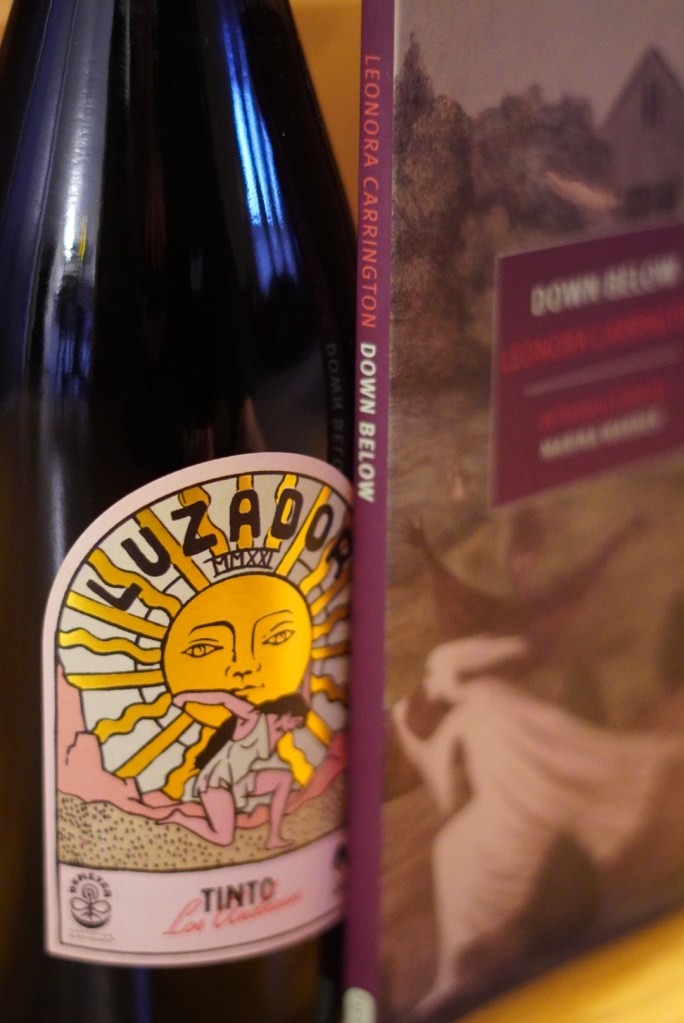
The wine to pair with the novella is as expressive as the story of Carrington. It could be a fall into madness or resemble a broken heart. There was a reason why I chose Carrington. It could be the novella; it could be her own personal story; it could be the artwork she created. Doesn’t that just infer her composition as a whole? I think so. There are deep emotions when reading Carrington. There is a truth and sensitivity that is brought out through an artist, that not everyone has the pleasure of being able, to not only show to the world, or perceive. The wine to pair with this novella is that of ease, but filled with depth. It provides the reader not only with substance, but removes the complexity.
The pairing for this poignant tale is from Spain, in the region of Navarra. A female wine maker, Ruth de Andres, birthed our vintage. Ruth portrays the strength of what it means to be a woman from not only the name, but from the artwork of the label. The wine is called Tinto “Los Andreses” from the producer Luzador. The shine brought to the label is that of the sun with a woman holding it up, surrounded by the pastel mountains. The quote, “A warrior of the sun, a fighter for light,” can be found on the back of the bottle. Carrington was a warrior and fought for her light by escaping the down below.

The female wine maker, the location, the purpose behind the wine and the design are all shining descriptions to align themselves with Leonora’s story. It is her own personal experience and own reality that she presents with truth through prose. This natural red blend of Garnacha and Tempranillo signify her story with ease, but put forth the intricate situation. Leonora escapes from the ‘down below’ and is freed. The wine is not only a depiction of triumph, but the taste of this rambunctious blend of black cherry and pomegranate will imprint your heart. Drinking Luzador’s wine while escaping from the ‘down below’ will be a freeing experience for not only Leonora, but for you, dear reader.
 The Library Vault
Leave a comment