
Who is Nero Wolfe? He is everyone’s favorite gourmet, orchid-growing, beer-loving, rotund, stay-at-home detective. One of the quirkier detectives ever invented, Nero Wolfe was the creation of author Rex Stout. Both Wolfe and Stout have been nominated for Best Mystery Series of the Century and Best Mystery Writer of the Century, respectively.
What makes Nero Wolfe different? His past is a mystery, so much so that over the years fans of the novels have evolved several theories about Wolfe’s origins. A favorite theory in Europe is that Nero Wolfe is the son of Arsène Lupin, famed fictional French thief (circa 1905) who supposedly had an affair with the queen of a Balkan principality. Since one of the few things we know about Wolfe’s early years is that he was born in Montenegro, a small country in Southeastern Europe, this theory has a big following. However, my favorite theory is that Wolfe is the son of none other than Sherlock Holmes and Irene Adler, the only person to ever out-maneuver the great Holmes.
These theories attempt to explain how a man like Nero Wolfe could possibly exist. Eccentric and aristocratic, brilliant and annoying, Wolfe is one of the odder detectives in a world where odd mystery-solving characters abound. He devotes his time to caring for one of the most extensive collection of orchids in New York City. To Wolfe, solving mysteries is a sideline that pays for the orchids. He definitely resents it when a case comes his way and he has to give his attention to that rather than caring for his orchids or planning gourmet meals with Fritz, Brenner, his personal chef.
“I rarely leave my house. I do like it here. I would be an idiot to leave this chair, made to fit me.”
— Nero Wolfe in the short story Before I Die (1947)
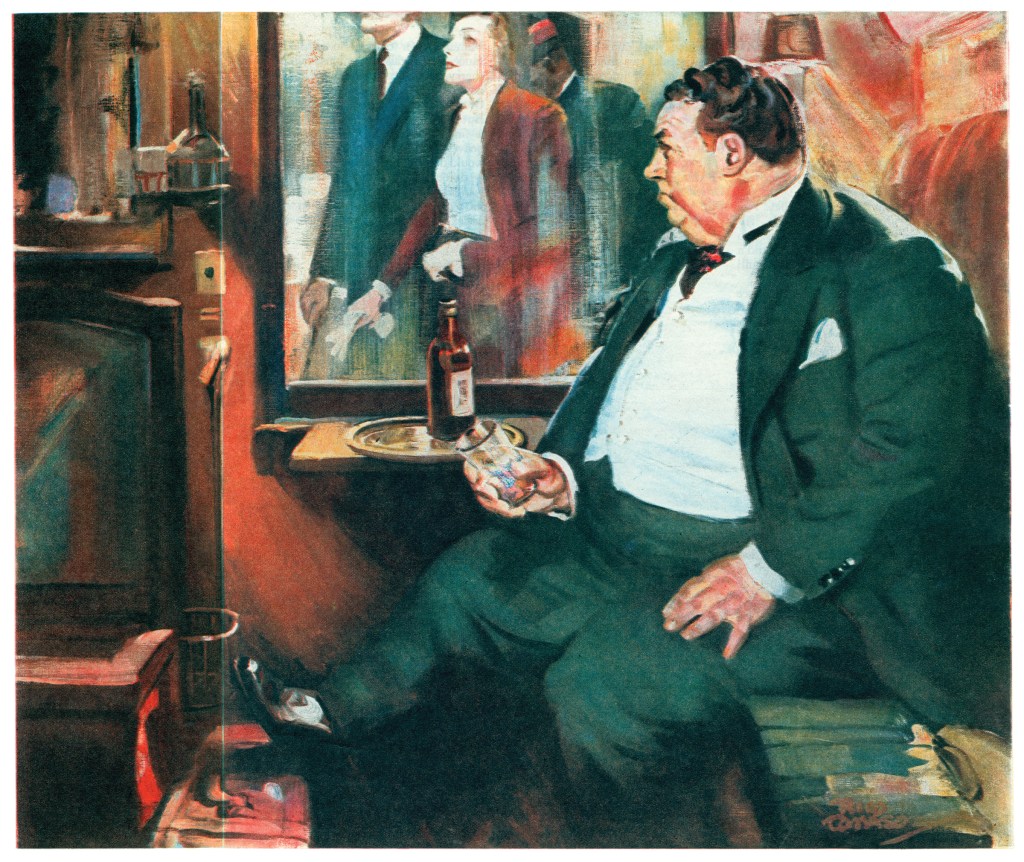
Wolfe even refuses to leave his house except in the most extreme circumstances, such as to purchase a rare orchid or to have a lavish meal at Rusterman’s, the one and only restaurant at which he is willing to dine. He hates public transportation and is rendered acutely miserable when he is forced to ride a train or take a taxi. (Read Too Many Cooks for a vivid portrait of Wolfe on a train!) He absolutely will not leave to pursue the business of solving mysteries. You might be asking, how does this hugely overweight, brilliant recluse manage to solve any crimes?
Enter Archie Goodwin, narrator of the Nero Wolfe books. Archie is the more traditional tough guy detective. Smart and sassy, with an eye for the ladies, Goodwin is Wolfe’s live-in assistant. He runs the errands, interviews witnesses, hunts for clues, and functions as the prod to get Nero moving when the great detective is reluctant to let yet another mystery take him away from the pleasant routine of his daily life.
Archie Goodwin is often compared to famous sidekicks John Watson (Sherlock Holmes) and Captain Arthur Hastings (Hercule Poirot), but he is so much more. Goodwin is integral to the solutions of the mysteries, not just tagging cluelessly along as the great detective solves the intricacies of the newest case. Goodwin is active where Wolfe is passive; he is emotional where Wolfe is remote to the point of insensitivity. Goodwin also has sharp wits and a ready tongue, one of the few things he has in common with his employer.
As Archie himself once noted, one of his jobs is to annoy Wolfe. He does this ceaselessly, often wielding sarcasm to make his points. He is great fun and a perfect counterpoint to the ponderous, cerebral Wolfe.
Wolfe was drinking beer and looking at pictures of snowflakes in a book someone had sent him from Czechoslovakia. … Looking at him, I said to myself, “He’s in a battle with the elements. He’s fighting his way through a raging blizzard, just sitting there comfortably looking at pictures of snowflakes. That’s the advantage of being an artist, of having imagination.” I said aloud, “You mustn’t go to sleep, sir, it’s fatal. You freeze to death.”
— Archie Goodwin in The League of Frightened Men (1935)
You would think these two would not be able to tolerate each other for more than a few minutes, but that is not the case. These two understand each other and the underlying component of their relationship is a true affection that both would rather die than admit. It is to be noted that the times that Nero Wolfe does leave his house for business reasons is to come to Archie’s aid, grumbling the entire time. In Death of a Dude, Wolfe actually boards an airplane, an unheard of form of transportation for him, to travel to Montana where Archie has been accused of murder. Archie, uncharacteristically, almost never points out these aberrations to Wolfe. To do so would be to acknowledge the unspoken affection that exists between them.
But don’t let Wolfe’s strict schedule and stubborn refusal to show emotion put you off the series. He is as much fun as Archie, in his own eccentric way. He can cast zingers with the best of them and his refusal to be intimidated by anyone, including the long-suffering police that have to deal with him, is a delight. His tussle with FBI director J. Edgar Hoover in The Doorbell Rang is memorable.
Wolfe is gruff but has a softer side. His love of food is renowned and he can’t stand to hear that anyone who has come to his door has missed a meal. Even folks that he is on the verge of throwing out of his house are treated to a gourmet dinner if he discovers that they have not adequately dined. And the day he learns that his best friend is dead, he comes as close to showing emotion as he ever does. The reader is left in no doubt about how he feels.
There are 33 novels and 41 novellas and short stories in the Nero Wolfe series. The first book, Fer-de-Lance, was written in 1934 and the last, A Family Affair, in 1975. Throughout the series, Nero and Archie never age. Rex Stout once said, “Those stories have ignored time for thirty-nine years. Any reader who can’t or won’t do the same should skip them. I didn’t age the characters because I didn’t want to. That would have made it cumbersome and would seem to have centered attention on the characters rather than the stories.” However, the Nero Wolfe stories did not end there.

Rex Stout’s biographer, John J. McAleer, once asked him, “How would you feel if someone wanted to continue the Wolfe series after you laid aside your pen?
Stout’s reply, “I don’t know whether vampirism or cannibalism is the better term for it. Not nice. They should roll their own.”
In spite of this declaration, Rex Stout’s estate did commission another author to continue the Nero Wolfe series after the author’s death. Robert Goldsborough wrote 17 novels about Nero Wolfe and Archie Goodwin. I will confess, I have not read them. They may be wonderful but I have yet to find an author who is able to continue a beloved series to my admittedly picky standards.
I suspect someday I will break down and read a few. I kind of want to know what Nero Wolfe has been up to since Rex Stout left him.
 The Library Vault
Leave a comment