
The Frederica Quartet by A.S. Byatt
A well written novel is timeless. An author who can produce a novel of excellence is also timeless. Their use of language is almost like a drug, each time you read a piece of their writing you ascend into a state of euphoria. You escape into another realm of consciousness. Art and the art of the novel has the ability to transcend, to make sense of the chaos. It creates a sense of order, it is a vision of a reality that has a beginning, middle and end. A.S. Byatt performs this art in the form of four novels. It is known as The Frederica Quartet.
A.S. Byatt is a familiar author to Wine & Words, I wrote about her Booker Prize novel Possession. Possession: A Romance was indeed timeless, but it did not drive me to embark on this journey of Frederica’s. The story of finding these novels was more in a sense of “berry picking.” “Berry picking” is a research termed coined by Marcia Bates – many librarians studied her in library school. The term is exactly what you would think: picking portions of information that leads you to another bit of information. Compiling a basket of berries: in this case, information. Information finding is not linear and neither is the world created by A.S. Byatt.
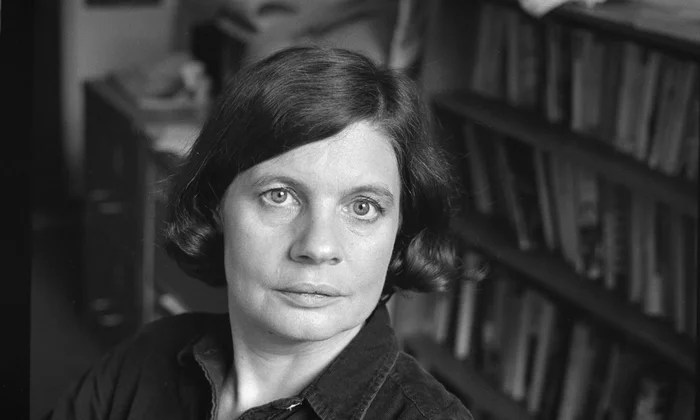
I will be honest. I will not delve too deep into the ‘compiling information’ portion because it is quite dull. Nor do I plan on providing a summary for each of the four novels that make up The Frederica Quartet. I would not want to read a blog post of that nature, nor do I think most readers would. The book jacket exists for a reason. Frederica is a complex character, but after conducting research, I was driven more to wonder how this character was developed. Who is A.S. Byatt, and what was mulling around in her mind to create this journey for readers? How did she accomplish this triumph over the course of decades? Why were there drastic breaks when writing this teratology? To find out, let’s start from the beginning.
Frederica Potter is the protagonist of this compilations of novels. The tale begins in 1953. When we reach the final novel, we find ourselves in 1970. It is a whirlwind adventure of characters, culture, societal norms, and – most importantly – literature. Frederica is the second child from the Potter family. The readers immediately become immersed with the family of intelligent academics who fawn over the act of reading. A critical event in England’s history runs parallel to the narrative, in which Queen Elizabeth II comes into the thrown. Side by side, Frederica and the Queen come of age, including the growth of other characters involved. The Virgin in the Garden is just the beginning of the unraveling of this literary family’s saga.
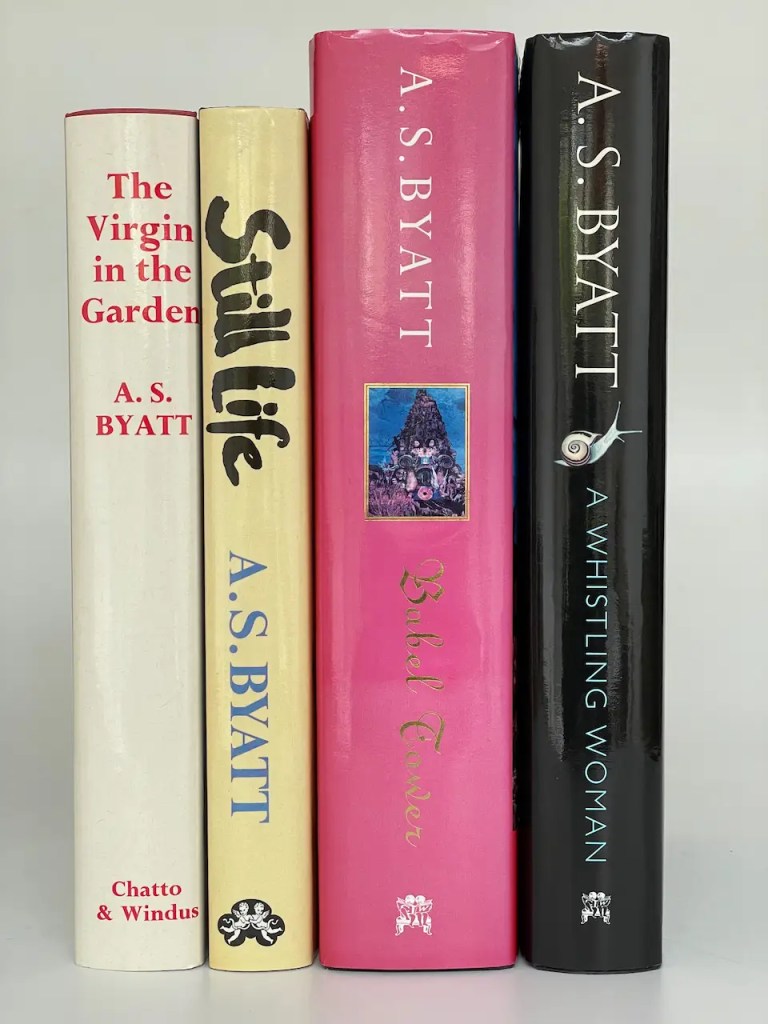
As readers, we follow Frederica through her times at Cambridge and becoming a woman. She confronts difficult decisions presented through life and art in Still Life. In Babel Tower, she overcomes a horrid marriage, while finding her own footing to continue her path of individuality. The quartet concludes with Whistling Woman, where the readers are presented with the end of the roaring sixties. The author reveals a truth behind the curtain, or maybe a television set. The reader will embrace Frederica’s tale like it is one of their own. A.S. Byatt is a phenomenal author who I can’t seem to put down. I’ve enjoyed escaping into a world that is sophisticated, but holds a sense of truth. Byatt cultivated the world of Frederica through a construction of literary prose, pairing structure with traditional literature that reigns with a familiar narrative.
A.S. Byatt was a sophisticated writer. Weaved throughout the words of Byatt’s prose is a familiar rendering that has hummed a similar tune. Isn’t imitation the highest form of flattery? Byatt uses references from great writers like D.H. Lawrence, George Eliot, the Brontë Sisters, and Shakespeare, and continues to play with literary devices in response to these writers through the characters created from the page. It was almost like trivial pursuit for readers of literature. It is not critical to the reader to be able to decipher, but it makes The Quartet more spellbinding in the world of Frederica. The Frederica Quartet is a slow burn of a teratology, just like A.S. Byatt’s composition of the four novels. The wine pairing for these novels is a delightful Lambrusco.

The specific Lambrusco is known as Lini 910 Labrusca Rose. The producers are the Lini family, since 1910 they have been producing the traditional-style of Lambrusco. What is lambrusco? Lambrusco is not only the name of the wine but also the grape it comes from. It is a sparkling wine that originates from northern Italy, in the region of Emilia-Romagna. It is believed to be one of the earliest grapes to produce wine. It is a food-friendly wine, traditionally dry. It can be paired with many different cuisines, not just Italian. It aligns well with A.S. Byatt’s narrative including well-known authors of literature.
Lambrusco is an inclusion of all cuisines. Specifically, the Lini are passionate about Lambrusco and understand that great wine takes time. They ages their wines until they are all ready to be released. It creates a unique bottle and sounds like a familiar tale for the composition of The Quartet. Byatt wrote it over the course of decades, patiently waiting for the story to unfold. Labrusca Rose is sophisticated like the character of Frederica, she is a complex character, the beautiful color resembles her beauty to be balanced with a juicy fruitiness through her evolvement throughout the novels. It is an ideal wine for a trailblazing teratology. The Frederica Quartet is timeless, but so is a bottle of Lini’s Lambrusco. If a novel can be timeless, then a why can’t a bottle of wine?
 The Library Vault
Leave a comment