By a Librarian-Mom
If you are a parent, grandparent, caregiver, child, toddler, preteen, teacher, or … other, you may have noticed these strange boxy-things in toy stores, Targets, libraries, and on ads. Somehow they’re related to books … or music? Or yoga? Or meditation? All of the above?
Yes.
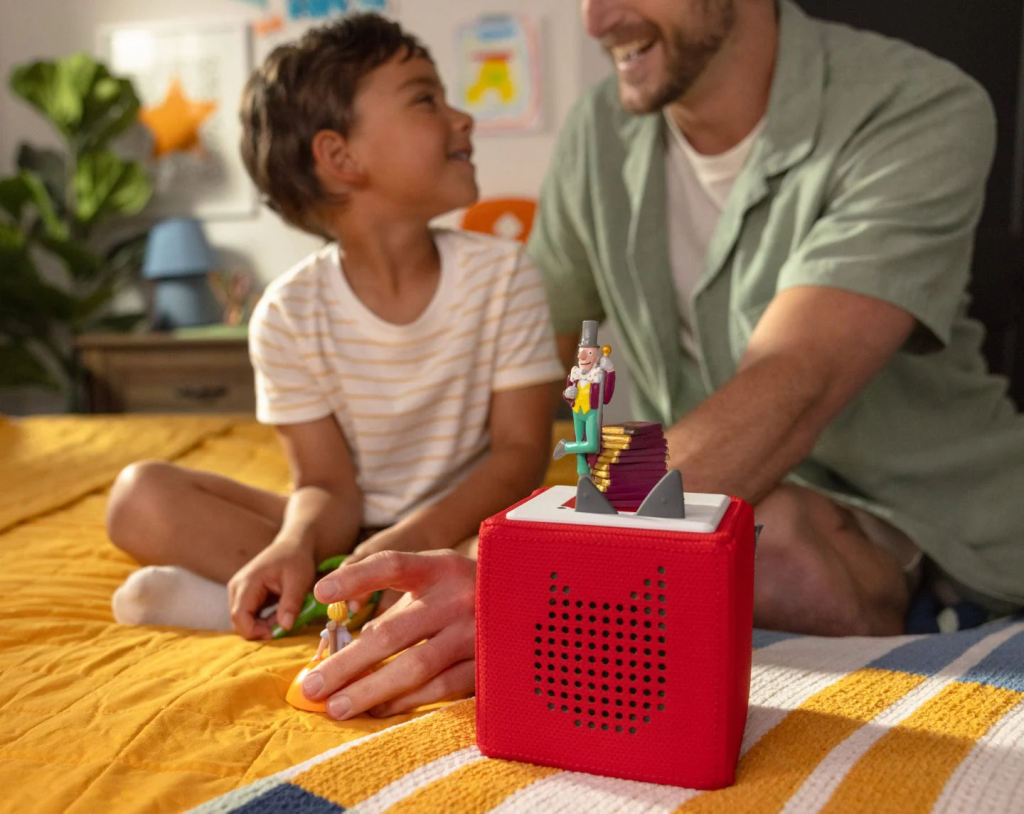
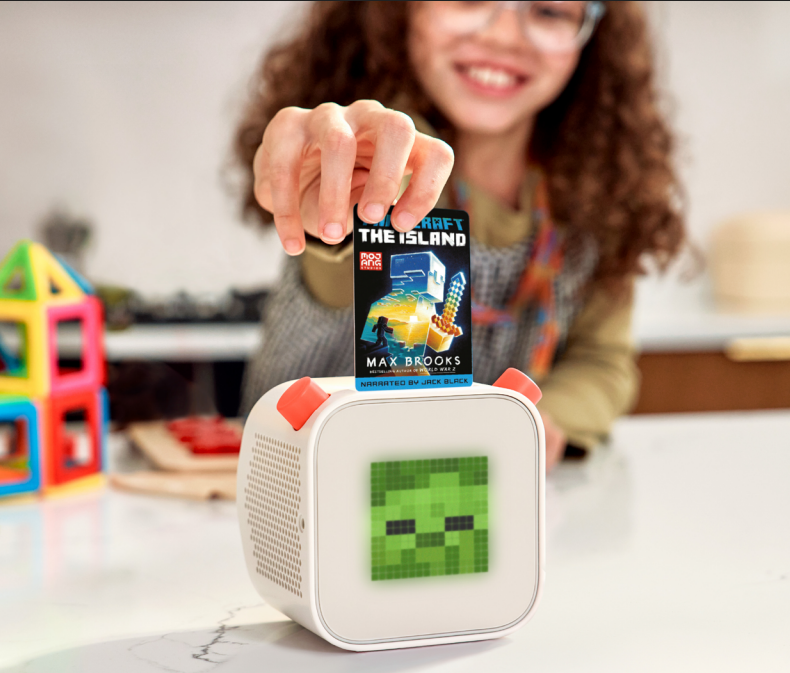
Tonies and Yotos are both essentially screen-free media players for kids. Many modern parents have become increasingly concerned about the rise in screen time for their kids, in an age when kids are on screens even at school. Many parents/caregivers are looking for ways to keep their kids off of televisions, computer screens, tablets, and video games, but still entertained – and preferably reading.
Libraries and youth librarians love this trend. Many libraries around the United States, and particularly in Connecticut, have begun circulating Tonieboxes, Tonie characters (called “Tonies”), Yoto Players, and Yoto cards. Russell Library circulates both formats to anyone who has a library card from any Connecticut public library.
But what’s the difference? Which should you try? Should you buy the boxes? How do they work?
As a librarian-mother of two kids who has test driven both formats at my own house, I can give you my personal recommendations. Both players work well at their intended goal: getting kids easy access to audiobooks, music, meditation, and yoga without screens. They are both about the same size, and both easy to travel with. Yotos have an additional Mini player, which is about half the size of the full sized player, but with fewer functions.
Both devices are sturdy and hard to break. In fact, my daughter taught me how to properly operate a Toniebox by showing me how to hit the side of it, hard: this changes chapters in a chapterbook Tonie. Careful librarian that I am, I was not hitting it hard enough. Both have also survived, undamaged, being thrown against walls in my house during tantrums. #Impressive.
Tonieboxes predate Yoto Players by about a year, so let’s start with them. Tonieboxes start around $90, but you can often get $10 or so off if you wait for a sale. “Tonies” (or tony characters) look like little toy action figures. They sit on top of the box, download the story/song/meditation/yoga/etc, and play the content on the built-in speaker. One downside of the Toniebox is that it does require an Internet connection to work, unless you pre-download the content and take the device offline. Connecting them to the internet is the biggest problem we’ve had with patrons borrowing Tonieboxes from the library and using them at home. It’s easiest if you download the app, but many people understandably don’t want to do that if they’re simply trying it out or don’t want to/can’t afford to buy one. You can successfully connect a borrowed Toniebox to your home internet without the app, but it’s harder that way.

Yoto Players, on the other hand, work even without connecting them to your home internet – even if it’s a loaner from the library. You simply insert the card into the top of the box, and it starts playing. This works even if you borrow a card from the library and use it on your home device. I’ve personally tested many of the library players and cards at home. I found it so easy that I ordered a Yoto Player the very first night. Yoto Players are a tad more expensive than Tonieboxes, starting around closer to $100, but again you can wait for a sale and get $10-20 off that way.
If you’re like me, you will get sick of your kid wanting the same Yoto card or Tonie figurine over and over, and you will want to buy that card or Tonie to save yourself the hassle of returning it to the library over and over again. In that case, Yoto cards are a bit less expensive than Tonies. Yoto cards tend to come in packs of 6 or 9, with prices averaging $30-50 a pack. A large chapter book like a Harry Potter will be around $30 – but in that case you only need the one card for the entire book. By comparison, Tonies cost $10-20 per figurine. The original Tonie productions cost around $10 each. The licensed materials (like Cocomelon or Frozen tonies) cost closer to $20. When you break down the cost per Yoto card vs. Tonie, Yoto cards are overall cheaper.


However, that’s where the library comes in. More and more public libraries in Connecticut circulate Tonies and Yoto cards for free. That way, you don’t have to buy any of them unless you want to. Russell Library has hundreds of Tonies and Yoto cards, with more on the way. We currently own 20 Tonieboxes that we circulate, and 8 Yoto Players – with 6 more Yoto Players on the way. If you don’t see what you want currently on our shelves, you can reserve what you want from our online catalog or friendly desk staff. We are constantly ordering more, because the demand is that high.
What about ages? Are both players appropriate for all kids? Well, no. Currently, the Tonies veer younger than the Yoto cards. They have a few chapter books like Roald Dahl’s Matilda, Charlie and the Chocolate Factory, and James and the Giant Peach, plus the first four Ramona books by Beverly Cleary, the first four Captain Underpants books, four Big Nate books, and the first Diary of a Wimpy Kid book. Tonies have a lot more licensed materials and franchises, like Teenage Ninja Turtles, the Grinch from How the Grinch Stole Christmas and practically every Disney princess you can think of. The age ranges on their website max out at ages 7-8.
Yoto cards, on the other hand, include a lot more chapter books. Their maximum age range is “9+”. They have a wider variety of offerings. They offer an increasing number of Diary of a Wimpy Kid books, classics like Treasure Island and Stuart Little, popular kids’ chapter book series like The Magic Treehouse and The Boxcar Children, A Series of Unfortunate Events, and Fantastic Beasts and Where to Finds Them – to name a few. There are dozens more. They also offer a wider variety of advanced nonfiction book cards, like Horrible Histories, Earth Explorers, and Astrophysics for Young People in a Hurry. They even offer a variety of popular music, from Kidz Bop albums to Beatles albums, to Queen, Abba, and Bob Marley music. In the 9+ category, they currently list 694 card packs for sale. For older kids, Tonies can’t compete with that – at least not yet.
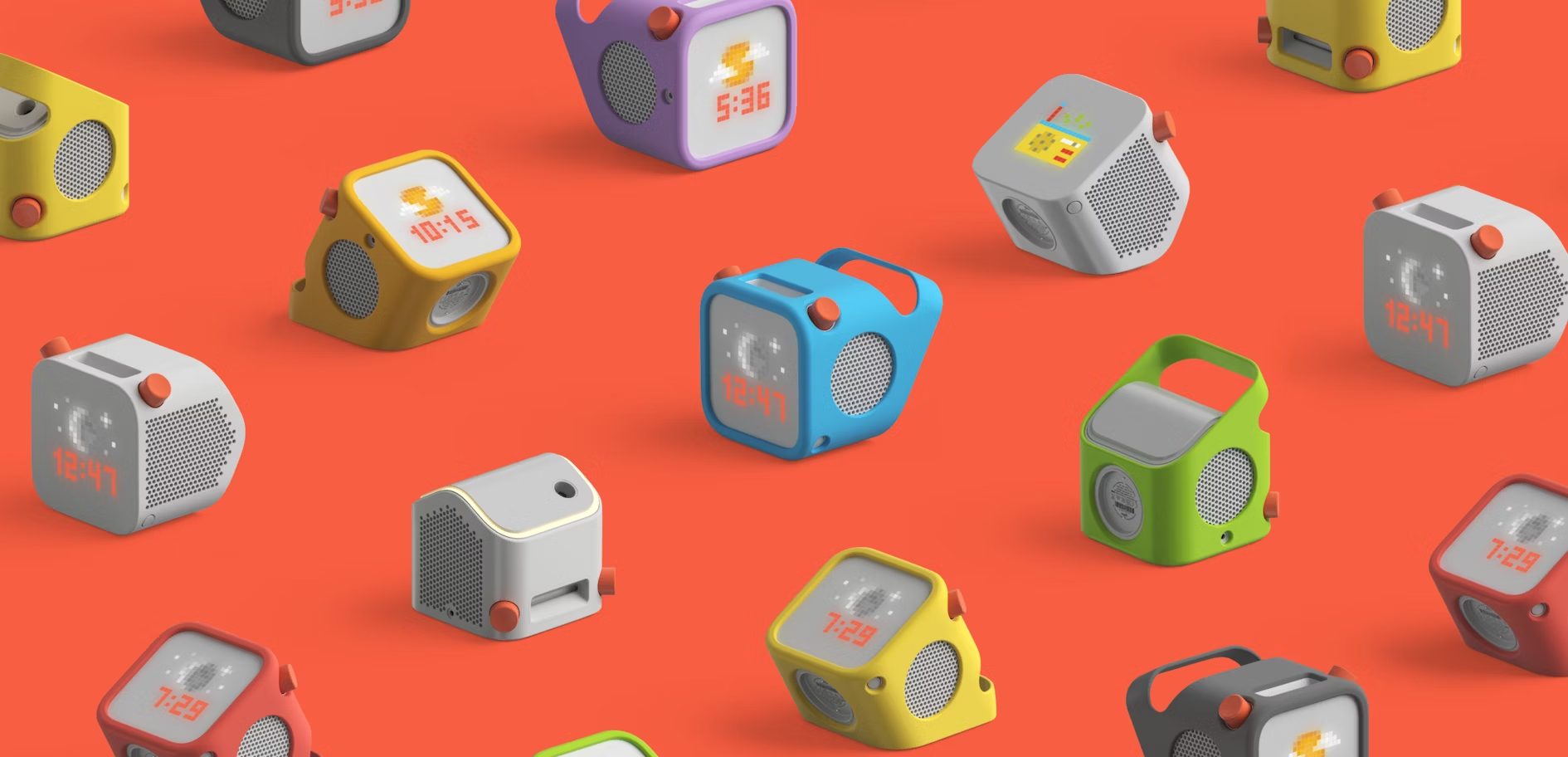
Yoto Players also offer functionality that Tonieboxes do not. Tonieboxes play Tonies, and that’s pretty much it. Yoto Players also serve as a digital clock, alarm, night light, and sleep-wake clock. They can display the weather and indoor temperature. They offer built-in kids’ radio stations: one for daytime, and one to help with sleep. Yoto Players can connect via Bluetooth to other devices, and serve as a Bluetooth speaker. You can even use the handy Sleep Timer to tell the Yoto Player when to stop playing a card.
On the other hand, the Yoto cards are more difficult to handle for younger kids than Tonies. A two-year-old can easily place a Tonie character on the Toniebox and get it to play without any help. That same child would probably have difficulty inserting a Yoto card into the Yoto Player. However, two-year-olds can greatly benefit from sleep-wake clocks, which the Yoto Players offer. You have to control these features from the Yoto app, so if you want to fully access them, I’d recommend buying your player instead of borrowing a library one.
Want to know more? Check out our catalog for all of our Yoto and Toniebox offerings. Happy listening!
 The Library Vault
Leave a comment