
The Historian by Elizabeth Kostova
Now, I have stated that working in a library does not allow librarians the pleasure to read all day. This is true. It does give us the pleasure of being surrounded by books. In this profession, we come across new books daily. We are given the privilege to be exposed to new authors, older books, and books of all types.
Libraries are made up of different departments and some of those departments allow a little more access to books than others. I know, it is shocking. One of those departments is known as Circulation. Here, at Russell we call it Borrowing & Discovery. Some institutions call it Access Services, some call it Tech Services and the list goes on. In most library circles, it is known as the Circulation Department. This is where books are catalogued, processed and literally circulated. This is not my main department; however, all staff members help to streamline the workflow. Whenever I assist in this department, I tend to walk away with more than I bargained for.
Working at a library is wonderful. It gives you access to so many books; however, that is where the trouble comes in. After working a shift in Circulation, I leave with maybe two or three books in hand. Patrons come back with returns and speak wonders of the novel they just read. I could be paging through some new books, and fall in love with the new Martha Stewart cookbook. Or the latest bestseller that was just returned.
I tend to walk away with more than I bargained for. One day when I was working, I came across a book called The Historian by Elizabeth Kostova. The title drew me in. (I hold a bachelors in history, so it was a given.) I just had to see what the book was about. I realized while processing this book that it was on hold for another patron. So, I needed to wait my turn. My pile of books at home doesn’t need anymore weight added to it anyway.
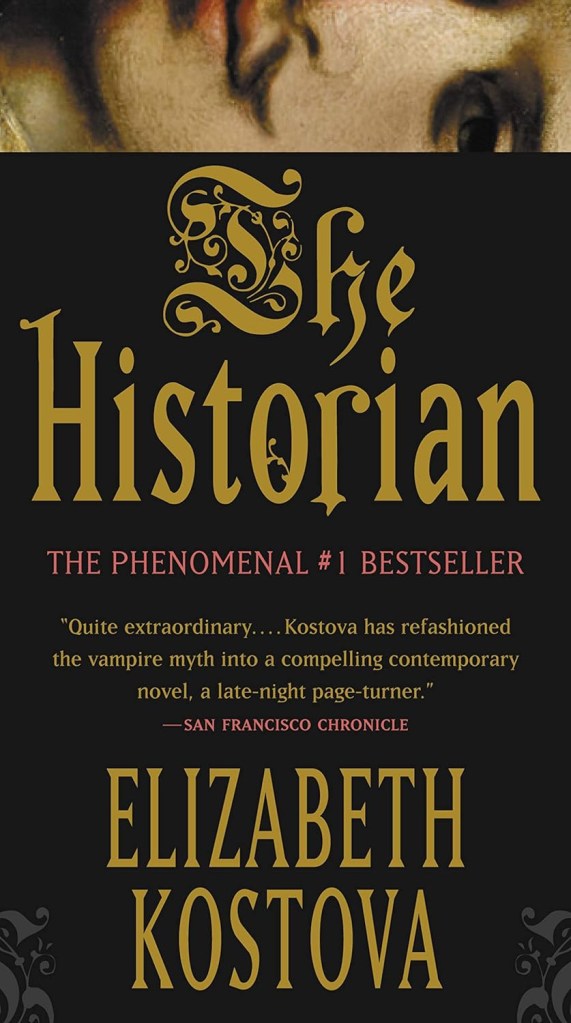
The Historian finally arrived! Apologies, for this play by play. If you are a frequent library user then you are aware the excitement when your hold comes in. It is comparable to when the package you have been waiting for has been delivered. The act of waiting and patience is truly a virtue. Since working in the department of Circulation is often more than I bargained for, I was not surprised that Elizabeth Kostova’s The Historian was too.
I thoroughly enjoyed this hunk of a novel, I truly did. It touched the inner researcher in me. Any person who loves a deep dive, researching, or Dracula will find it fascinating. It has spun me down a different rabbit hole that I did not know I would be pursuing. But more on that later.
Kostova’s novel begins with a young woman exploring her father’s library who comes across a pile of letters located in antiquarian book. These letters are tainted yellow and have seen their fair share of years. The uncanny letters begin with “my dear and unfortunate successor.” Now, why would her father have such letters and who is this unfortunate successor? Kostova takes the reader on a journey that weaves through time, across centuries and explore the far facets of Eastern Europe. All of this is centered around one of histories darkest beings: Dracula. Does Dracula really exists? It is up to this young woman to find the truth. Following in her father’s footsteps, she uses a written account of his explorative research to find the resting place of Vlad the Impaler. Researchers have risked their lives to decipher if a legend and truth are one.

I devoured this novel. It is historical fiction that holds an eerie dusty undertone. Some have described Kostova’s novel as horror; however, I don’t think that is accurate. Yes, the main figure is Dracula, but blood and gore do not hold center stage. There is an evil librarian, which just entertains me to no end. But, what Kostova does is take the reader on a voyage through libraries, archives, and monasteries, unveiling the authenticity from documents, manuscripts and letters deciphering the past. It is a researchers dream, sparking wanderlust to the Balkans, Bulgaria, Romania and a tour de force of Eastern Europe.
Kostova’s tale is an academic venture that ‘feels like velvet’ until the introduction of the man, the myth, the vampire Dracula. The adventure comes to an untimely halt with an uneventful ending; however, I think the expedition is what entices the reader to explore the world Kostova created. The clichéd subject matter is a faint concept compared to what is actually occurring in the novel. It feels realistic and factual with the skepticism discreetly present. Kostova has bestowed upon the reading community an undertaking for the researcher, luring their desire to trek from clue to clue to unveil truth.
With Dracula in mind, what to pair with The Historian? I could venture off and not decide on a wine or be a cliché, like the topic of the novel. I think I will remain cliché.

How could I not choose a red wine to pair with Elizabeth Kostova’s novel, The Historian? When one thinks of Dracula they think not only of vampire, but of blood. This is not some juicy red. No, the wine I chose comes from a region similar to that of the plot of the novel. It is a Slovenian wine, and personally, I think Slovenia makes wonderful wine. They are not too juicy nor fruit forward, but hold a dryer taste that is grounded and earthy.
I think location is crucial to the flow of the novel and so I paired Kostova’s novel with something that is parallel to the descriptions. Choosing a wine from the region that these characters travel to, does justice to Kostova’s work of fiction. Now, it’s time to describe the wine.

The wine is a pinot noir from the winery Sanctum located in the northeast region of Slovenia in the town of Loče. The wine is called Sanctum Lisica Pinot Noir, it sustainable viticulture, basically environmentally friendly. These pinot noir grapes have been growing in this region since the 12th century by French monks. Monasteries were keen locations throughout The Historian, not only for information but for the potential resting places of Dracula. The region and the history of these grapes correspond with Kostova’s novel. Like the story, this wine is a little something more than was bargained for.

Since the grapes are grown in the hands off approach, there is minimal intervention of the wine. The wine is spontaneously fermented, which lets the wine speak for itself and represent the terroir and the region that was curated by the monks so many centuries ago.
As readers, we travel through time and unearth the complexities of research and genuineness, almost at a bargain price. Then as drinkers we can align ourselves with a wine so purposefully assembled, at a risk of spontaneity, that it could be a bargain itself. If any of us were to come across Dracula, wouldn’t that be a bargain too! All these things to think about.
Enjoy this light earthy pinot noir that represents more than just the earth it comes from. So, have a glass and follow these academics around while they are on the hunt for Dracula.
 The Library Vault
Leave a comment